Figuring out how to pray can feel challenging, but having the right direction turns it into a beautiful, calming routine. This salah guide is designed to simplify exactly how to pray salah without confusion or overwhelm. We’ll walk through the core salah steps together, so you can build your confidence and start praying with a clear, focused mind.
Before we walk through the salah steps, if you haven’t read Part 1 of this series yet, I encourage you to start there first by clicking here. That initial salah guide covers the essentials you need before learning how to pray salah; from spiritual readiness and the right mindset, to practical preparation like cleanliness, performing wudu, and finding a suitable place to pray.
Salah Steps
Below we provide the English, Arabic and English transliteration as well as instructions on how to perform each step with visuals.

Step 1: Make Your Intention (Niyyah)
Face your mat toward Qiblah and stand up to pray. Make a clear intention in your heart
You do not need to say it aloud because uttering the intention verbally is a bid’ah which goes against the Sunnah. Instead, focus on which prayer you are performing. For example, you may intend Fajr or Dhuhr. This step prepares your mind for Salah.

Step 2: Begin with Takbir (Allahu Akbar)
Next, raise your hands and say the following.
Allahu Akbar
God is the greatest
اللّٰهُ أَكْبَر
This begins your Salah. Then place your right hand over your left on your chest.

Step 3: Dua Al-Istiftah (Opening Supplication)
This is established from the Sunnah and should be observed.
Subhanaka Allahumma wa bihamdika, wa tabaraka ismuka wa ta’ala jadduka, wa la ilaha ghayruka
Glory and praise be to You O Allah, blessed be Your name and exalted be Your Majesty, and there is no god but You.
سُبْحانَكَ اللَّهُمَّ وَبِحَمْدِكَ، وَتَبارَكَ اسْمُكَ، وَتَعَالَى جَدُّكَ، وَلاَ إِلَهَ غَيْرُكَ
There are other opening duas but this is the main and it is established from the Sunnah and should be observed. You can recite other opening duas/ dhikr that you might know after this
Step 4: Seeking Refuge
Before reciting Surah Al Fatiha seek refuge in Allah, this is obligatory. Recite:
auzu billahi minash shaitan rajeem
I seek Allah’s protection from Satan, the accursed.
اعوذ باللہ من الشیطان الرجیم
Step 5: Basmalah
Now recite:
bismillah hir rahman nir Raheem
In the name of Allah who is kind and merciful.
بسم الله الرحمن الرحيم
Step 6: Recitation of Al Fatiha
Recite:
Alhamdu lillaahi Rabbil
aalameen Ar-Rahmaanir-Raheem
Maaliki Yawmid-Deen
Iyyaaka na’budu wa lyyaaka nasta’een
Ihdinas-Siraatal-Mustaqeem
Siraatal-lazeena an’amta ‘alaihim
ghayril-maghdoobi ‘alaihim wa lad-daaalleen
In the Name of Allah—the Most Compassionate, Most Merciful.
All praise is for Allah—Lord of all worlds,
the Most Compassionate, Most Merciful,
Master of the Day of Judgment.
You [alone] we worship and You ˹alone˺ we ask for help.
Guide us along the Straight Path,
the Path of those You have blessed—not those You are displeased with, or those who are astray.
بِسْمِ ٱللَّهِ ٱلرَّحْمَـٰنِ ٱلرَّحِيمِ
ٱلْحَمْدُ لِلَّهِ رَبِّ ٱلْعَـٰلَمِينَ
ٱلرَّحْمَـٰنِ ٱلرَّحِيمِ
مَـٰلِكِ يَوْمِ ٱلدِّينِ
إِيَّاكَ نَعْبُدُ وَإِيَّاكَ نَسْتَعِينُ
ٱهْدِنَا ٱلصِّرَٰطَ ٱلْمُسْتَقِيمَ
صِرَٰطَ ٱلَّذِينَ أَنْعَمْتَ عَلَيْهِمْ غَيْرِ ٱلْمَغْضُوبِ عَلَيْهِمْ وَلَا ٱلضَّآلِّينَ
Recite Surat al-Fatiha completely, including the basmalah. This is a pillar of prayer; without it the prayer is invalid.Those unable to read Arabic must learn it. If unable, they should say: “Subḥān Allāh, wal-ḥamdu lillāh, wa lā ilāha illallāh, Allāhu akbar, wa lā ḥawla wa lā quwwata illā billāh.”
Step 7: Recitation of passage from the Quran
Recite :
Bismillah hir Rahman nir Rahim
Qul Huwallahu ahad.
Allahussamad.
Lam yalid wa lam yu-lad.
Wa lam yakun lahu kufuwan ahad.
In the name of Allah, the most Gracious, the most Merciful.
Say, He is Allah, the One.
Allah is Eternal and Absolute.
He begets not, nor was He begotten.
And there is none co-equal unto Him.
قُلْ أَعُوذُ بِرَبِّ ٱلنَّاسِ
مَلِكِ ٱلنَّاسِ
إِلَـٰهِ ٱلنَّاسِ
مِن شَرِّ ٱلْوَسْوَاسِ ٱلْخَنَّاسِ
ٱلَّذِى يُوَسْوِسُ فِى صُدُورِ ٱلنَّاسِ
مِنَ ٱلْجِنَّةِ وَٱلنَّاسِ
After the recitation of Surah Al Fatiha, you may recite another short Surah or passage from the Quran. Beginners will start with Surah Iklas as its the shortest surah.
In the 3rd and 4th rak’ahs, only recitation of Surah Al-Fatiha is required. YOu should not read a pasage of the quran.
Reciting Aloud and Silently in Prayer
Recite aloud in: Fajr, Jumuah, ‘Eid prayers, Istisqa (rain prayer), Kusuf (eclipse prayer), and the first two rak’ahs of Maghrib and Isha.
Recite silently in: Zuhr and Asr (all rak’ahs), the third rak’ah of Maghrib, and the last two rak’ahs of Isha.
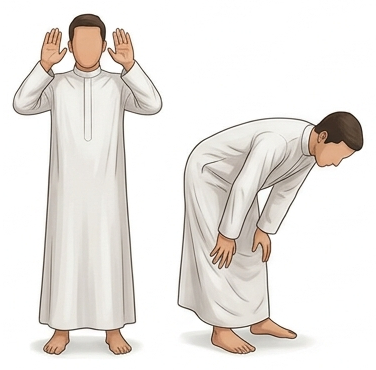
Step 8: Perform Ruku (Bowing)
Now say “Allahu Akbar” and raise both hands as in takbirat al-ihram (the takbir at the beginning of prayer) and bow down. Keep your back straight and hands on your knees and recite the following three times.
Subhana Rabbiyal Adhim
Glory be to my Lord Almighty.
سُبْحَانَ رَبِّيَ الْعَظِيمِ
There are other kinds of dhikr which may be said at this point. However, it is not permissible to recite Quran in Ruku.
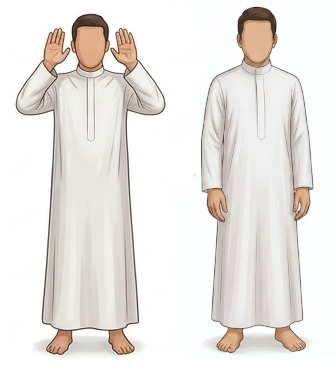
Step 9: Stand Up From Ruku
After Ruku, stand up straight. While rising, say:
Sami’Allahu liman hamidah
Allah hears those who praise Him.
سَمِعَ اللَّهُ لِمَنْ حَمِدَه
and raise both hands as in takbirat al-ihram (the takbir at the beginning of prayer). Then say:
Rabbana lakal hamd
Our lord, to you be the praise.
رَبَّنَا وَلَكَ الْحَمْد
There are other kinds of dhikr which may be said at this point.
Step 10: Perform Sujood (Prostration)
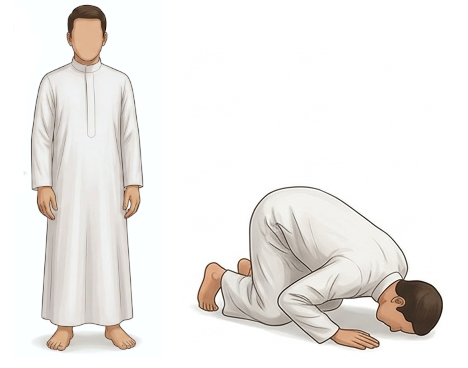
say
Allahu Akbar
God is the greatest
اللّٰهُ أَكْبَر
and go into sujood (prostration).
When going into prostration, you should:
- Keep your fingers together and point them toward the qiblah.
- Place your palms on the ground, level with your shoulders (sometimes level with his ears).
- Keep your forearms lifted off the ground and not spread out flat on the ground like how a dog sits.
- Place your forehead and nose firmly on the ground (this is essential).
- Place your knees firmly on the ground.
- Place your toes on the ground with his feet upright.
- Point your toes toward the qiblah.
- Keep your heels close together.
In this position, the body should be steady, balanced, and relaxed.
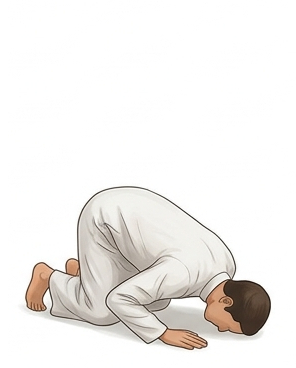
Step 11: While in Sujood (Prostration)
Now, say the following three times:
Subhana Rabbiyal A’la
How Perfect is my Lord, the Highest
سُبْحَانَ رَبِّيَ الأَعْلَى
There are other kinds of dhikr which may be said at this point. It is recommended to offer a lot of dua during sujud, because it is a time when dua is likely to be answered. However, it is not permitted to recite Quran whilst in the sujud (prostration).
It was narrated from Abu Hurairah that: The Messenger of Allah (ﷺ) said: “The closest that a person can be to his Lord, the Mighty and Sublime, is when he is prostrating, so increase in supplication then.” (Sunan an-Nasa’i: Book 12, Hadith 109)
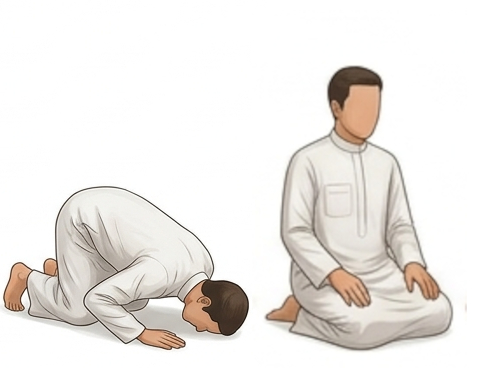
Step 12: Sitting Between the Sujood
While still in sajood say:
Allahu Akbar
God is the greatest
اللّٰهُ أَكْبَر
and come up into the sitting position and say the following two times:
Rabbighfir li
My Lord, forgive me
رب اغفر لي
Sit on the left thigh with the top of the left foot laid flat on the ground. Keep the right foot upright, with toes facing the Qiblah. Place the hands on or just above the knees.
There are other kinds of dhikr which may be said at this point.
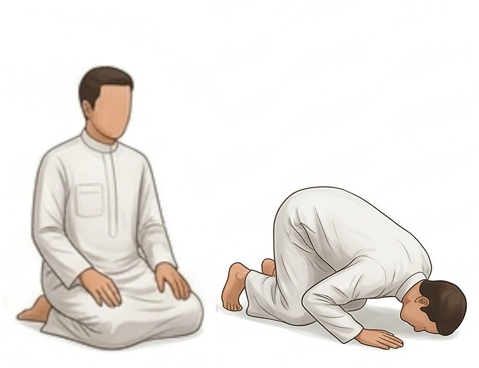
Step 13: Go back in Sujood (Prostration)
Go back in Sajood and Say the following three times:
Subhana Rabbiyal A’la
How Perfect is my Lord, the Highest
سُبْحَانَ رَبِّيَ الأَعْلَى
and come back up into the seated position
Step 14: Sitting up from Sujood
Now say:
Allahu Akbar
God is the greatest
اللّٰهُ أَكْبَر
And sit up.
- After the second sujood (prostration), say takbir (obligatory) when rising.
- Sit briefly on the left foot until the body settles.
If you are at the end of the 1st or 3rd rakah then stand up go back to step 5.
If you are in the 2nd or 4th rakah then go to step 15.

Step 15: Sitting for the Tashahhud
Now, while sitting say:
Al-tahiyyatu Lillahi wa’l-salaawatu wa’l-tayyibat.
Al-salamu ‘alayka ayyuha’l-Nabiyyu wa rahmat-Allahi wa barakatuhu.
Al-salamu ‘alayna wa ‘ala ‘ibad-Illah il-salihin.
Ash-hadu an la ilaha ill-Allah wa ash-hadu anna Muhammadan ‘abduhu wa rasuluhu [point with the right index finger towards the Qibla]
All compliments, prayers and pure words are due to Allah.
Peace be upon you, O Prophet, and the mercy and blessings of Allah.
Peace be upon us and upon the righteous slaves of Allah.
I bear witness that there is no god except Allah, and I bear witness that Muhammad is the slave and Messenger of Allah
التَّحِيَّاتُ لِلَّهِ وَالصَّلَوَاتُ وَالطَّيِّبَاتُ،
السَّلاَمُ عَلَيْكَ أَيُّهَا النَّبِيُّ وَرَحْمَةُ اللَّهِ وَبَرَكَاتُهُ،
السَّلاَمُ عَلَيْنَا وَعَلَى عِبَادِ اللَّهِ الصَّالِحِينَ،
أَشْهَدُ أَنْ لاَ إِلَهَ إِلاَّ اللَّهُ وَأَشْهَدُ أَنَّ مُحَمَّدًا عَبْدُهُ وَرَسُولُهُ
When you recite the shahadah at the end, close the fingers of the right hand; place the thumb with the middle finger (sometimes forming a circle). Point with the index finger towards the qiblah and look at it.
While pointing with the right index finger keep the hand where it is on the thigh. You just need to bring all the other fingers and thumb together while raising the index finger.
- Do not use the left hand for pointing. This applies in every Tashahhud.
- The Tashahhud is obligatory; if missed (prostration of forgetfulness) is required.
- It should be recited silently.
- If you are at the end of the 2nd rakah and have more rakahs left then say Allahu akbar, stand up and go back to step 5. It is Sunnah to briefly sit upright before standing.
- If you are at the end of your last rakah then proceed to step 16.
Step 16: Final Tashahhud (Last Sitting)
Now whilst you are still sitting down, recite the following:
Allahumma salli ‘ala Muhammad wa ‘ala ali Muhammad kama salayta ‘ala Ibrahim wa ‘ala ali Ibrahim, innaka hamidun majid.
Allahumma barik ‘ala Muhammad wa ‘ala ali Muhammad kama barakta ‘ala Ibrahim wa ‘ala ali Ibrahim, innak hamidun majid.
O Allah, send prayers upon Muhammad and upon the family of Muhammad, as You sent prayers upon Ibrahim and upon the family of Ibrahim; You are indeed Worthy of Praise, Full of Glory.
O Allah, send blessings upon Muhammad and upon the family of Muhammad as You sent blessings upon Ibrahim and upon the family of Ibrahim); You are indeed Worthy of Praise, Full of Glory.
ٱللَّٰهُمَّ صَلِّ عَلَىٰ مُحَمَّدٍ وَعَلَىٰ آلِ مُحَمَّدٍ كَمَا صَلَّيْتَ عَلَىٰ إِبْرَاهِيمَ وَعَلَىٰ آلِ إِبْرَاهِيمَ إِنَّكَ حَمِيدٌ مَجِيدٌ
ٱللَّٰهُمَّ بَارِكْ عَلَىٰ مُحَمَّدٍ وَعَلَىٰ آلِ مُحَمَّدٍ كَمَا بَارَكْتَ عَلَىٰ إِبْرَاهِيمَ وَعَلَىٰ آلِ إِبْرَاهِيمَ إِنَّكَ حَمِيدٌ مَجِيدٌ
The final tashahhud is obligatory.
Step 17: Seeking Refuge (Before Ending)
Now whilst you are still sitting down, recite the following:
Allahumma inni a’ūdhu bika min ‘adhābi Jahannam, wa min ‘adhābi al-qabr, wa min fitnat al-maḥyā wal-mamāt, wa min sharri fitnat al-Masīḥ ad-Dajjāl.
O Allah, I take refuge in You from the punishment of the grave, from the torment of the Fire, from the trials and tribulations of life and death and from the evil affliction of Al-Maseeh Ad-Dajjal
اللَّهُمَّ إِنِّي أَعُوذُ بِكَ مِنْ عَذَابِ القَبْر، وَمِنْ عَذَابِ جَهَنَّمَ، وَمِنْ فِتْنَةِ الْمَحْيَا وَالْمَمَاتِ، وَمِنْ شَرِّ فِتْنَةِ الْمَسيحِ الدَّجَّالِ

Step 18: Taslim (Ending the Prayer)
Turn your head to the right and say:
As-salamu alaykum wa rahmatullah
peace and the mercy of Allah be on you.
السَّلاَمُ عَلَيْكُمْ وَرَحْمَةُ اللهِ
Now turn your head to the left and say:
As-salamu alaykum wa rahmatullah
peace and the mercy of Allah be on you.
السَّلاَمُ عَلَيْكُمْ وَرَحْمَةُ اللهِ
Now look forward
The salah is now complete. It is recommended to make Dhikr afterward, and to pray any applicable sunnah prayers.
It is also worth noting that there are optional supplications (duas) that can be recited between each position in Salah. For example, you may make additional duas during Ruku and Sujood or while sitting. Although not obligatory, these supplications increase focus and reward. Therefore, learning them gradually improves your connection with Allah.
As you continue practising how to pray salah, keep this salah guide close as a reminder that you are never alone in your journey. The salah steps you’ve learned today form the framework of a deeply personal relationship with Allah. May your prayers remain steadfast, your heart stay soft in sujood, and your soul find its ultimate peace in devotion.
Now that you’ve learned the core salah steps, there’s just one more prayer to cover: Witr. Click here to go to the final part of this salah guide, where we walk through exactly how to pray salah al-Witr and bring your knowledge full circle.
For more articles click here.